For three years, I searched for the person I believed had taken my daughter. Then a teacher recognized her in a school photo, and the trail led me to a house filled with birthdays, school plays, and three years of a childhood I never got to witness.
I thought I was following a trail back to Emily.
I didn’t understand I was also following it back to something else.
What waited in that house wasn’t a kidnapper. It was the truth none of us had been brave enough to face.
What waited in that house wasn’t a kidnapper.
***
I lost my second baby in my sixth month of pregnancy. A girl we’d already named, whose room we’d already painted, whose small folded onesies were stacked in a drawer.
I won’t describe what that does to a person except to say that the version of me who walked into that hospital was not the same version who walked out.
And I never fully found my way back to her.
I lost my second baby in my sixth month of pregnancy.
***
Mike tried to hold things together. He threw himself into work, into routines, into parenting our daughter, Emily, with a steadiness I couldn’t match.
I was present in the physical sense. I fed her, drove her to school, and sat beside her at dinner.
But emotionally, I was somewhere else.
Some mornings I functioned perfectly well. Other mornings I sat at the kitchen table until Emily had to remind me the school bus was coming.
Emotionally, I was somewhere else.
Emily was five when we lost the baby. Six when the arguments started.
Eight when Mike and I finally stopped pretending the marriage could survive what we’d done to it.
The divorce was nobody’s fault and everyone’s fault, which is the worst possible version.
I used to rehearse a cleaner story for myself, one where I was more victim than participant.
Emily was five when we lost the baby.
Grief takes things from you, and one of the things it took from me was the ability to see clearly how much I was contributing to the damage. That’s not an excuse. It’s just the truth.
We tried shared custody the way two people try to share a house they’ve both already moved out of, with good intentions and terrible execution.
Emily went back and forth between us for about a year. She was quiet in the way children get quiet when they’re absorbing things adults think they’re hiding.
Grief takes things from you.
Then the legal letters started.
Then came the arguments about the legal letters. The arguments became court filings. The court filings became something neither of us could look at without feeling our chest tighten, so eventually Mike and I stopped looking.
We stopped talking entirely.
Mike took a position several towns away. He told me it was temporary. I told my lawyer it wasn’t.
We stopped talking entirely.
Somewhere in the machinery of all those accusations and counter-accusations, something broke that I didn’t notice breaking. Because I was too busy being angry to see what was slipping away.
Three years passed.
The police eventually stopped calling. With no witnesses, no ransom demands, and no evidence of a crime, the case slowly settled into the cold, unresolved category nobody wants their child to become.
I still set the table for two every night, which I knew was irrational and did, anyway.
The call came on an ordinary Tuesday.
I was too busy being angry to see what was slipping away.
I was folding laundry when my phone rang. A number I didn’t recognize, from an area code I didn’t know.
“Mrs. Parker?” The voice was careful. Measured. The voice of someone who had rehearsed what they were about to say. “This is Principal Miller at Brookside Elementary. It’s about your daughter. I think you need to come in as soon as possible.”
“I’m sorry,” I said slowly. “My daughter doesn’t attend Brookside.”
A pause on his end.
“My daughter doesn’t attend Brookside.”
“I know,” he replied. “That’s why I’m calling. A teacher recognized your daughter in a photo a student brought to school.”
My hands went still.
He explained it carefully. A student had submitted a photo collage for a regional exhibition. One of the teachers reviewing the work had stopped at a particular photograph — a group of children at what looked like a summer picnic, laughing, posed casually the way children do when nobody tells them to smile.
She recognized a face.
She recognized a face.
Years earlier, she’d worked in a district near mine. She remembered the flyers. The news coverage. The face of a little girl named Emily, eight years old, last seen leaving school on a Wednesday afternoon three years ago.
The face in the photograph was older.
But it was the same face.
My missing daughter’s face.
She remembered the flyers.
***
I was already reaching for my coat.
I drove across town in a way I am not proud of.
The 40 minutes felt simultaneously like no time at all and like an eternity.
I rehearsed nothing. I had no plan beyond getting to the school and seeing what was there.
I rehearsed nothing.
Principal Miller met me at the door himself and walked me to his office without small talk, which I appreciated.
A teacher was already seated inside, younger than I expected, with the still, careful expression of someone who understood the gravity of what they’d found and was not treating it lightly.
She slid the collage across the table without a word.
She slid the collage across the table without a word.
I looked at it for three full seconds before the room seemed to tilt.
Emily.
Not the eight-year-old face I’d been staring at on flyers for three years — rounder, younger, gap-toothed in that particular way of second-graders.
This face was eleven. Her jaw had lengthened slightly. Her hair was longer. But her eyes were the same eyes, and the way she was laughing with her head slightly back was something I had watched her do her entire life.
This face was eleven.
She looked healthy. She looked happy. She was… alive.
Somehow that made it worse before it made it better.
“Where did this come from?” I managed.
“A student named Daniel,” the teacher said gently. “He transferred here recently. His mother lives about 40 minutes from here.”
“Where did this come from?”
She wrote down the address herself, in clear block letters, and handed it across the table.
I raced there, my heart pounding with hope as tears kept spilling down my face at the thought of seeing my daughter.
The woman who answered the door was around my age, dark-haired, with the look of someone who had been expecting a knock like this for a long time and had never quite made peace with it.
Her eyes dropped immediately to the photograph in my hand.
I raced there, my heart pounding with hope.
All the color left her face.
“My name is Karen,” she said after a moment. “Please come inside.”
I stepped through the door.
What I saw stopped me entirely.
All the color left her face.
***
The walls were covered in photographs. Not in a strange way, but in the way homes look when a child is deeply loved.
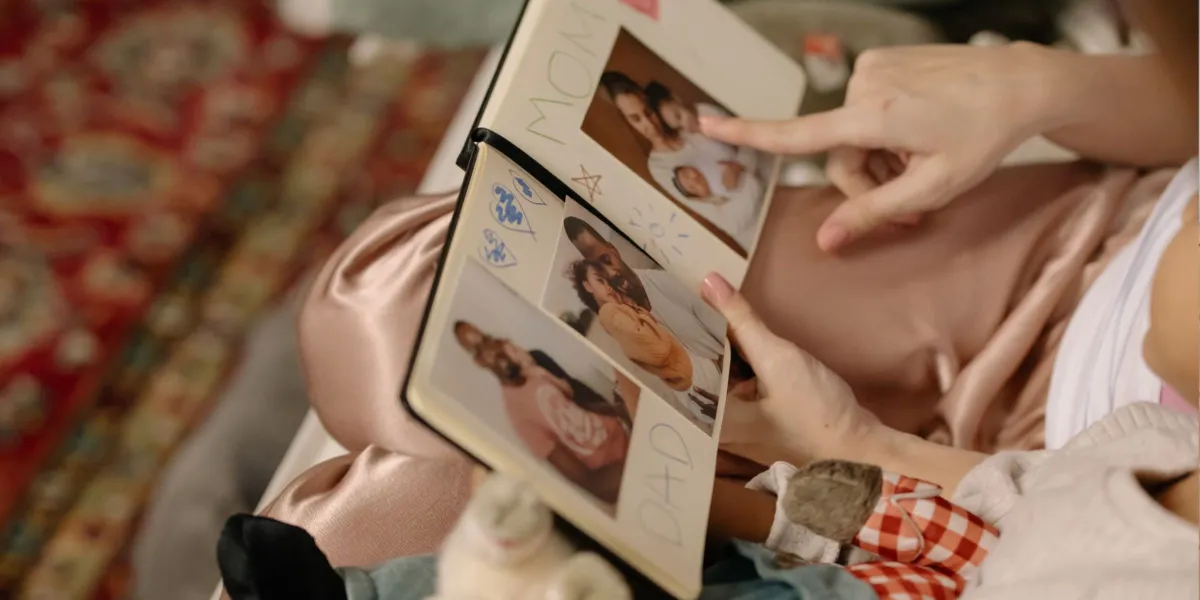
There were birthday parties with balloons. A school play where a little girl was dressed as a sunflower. A Halloween costume with a green witch hat and an enormous grin. A soccer game, caught mid-run with her arms out for balance. A science fair ribbon. A summer afternoon with a garden hose.
Three years of Emily’s life.
Three years of birthdays and seasons and ordinary afternoons that I had not been part of.
The walls were covered in photographs.
I stood in Karen’s living room and felt something in me break open.
Three years of my daughter growing up in photographs I had never seen. Three years of her smile in moments I hadn’t been there for.
I had missed all of it.
I had missed all of it.
***
“She was never locked away,” Karen said softly, from somewhere behind me. “She was never hidden. She’s been living a normal life. She has friends, and a school she likes, and she’s doing well.”
“Then why didn’t anyone tell me?” I asked, turning around.
Karen looked at the floor for a long moment. Tears filled her eyes.
“I’m not directly responsible,” she admitted. “I told him this would happen. I told him you would find her, eventually.”
“Why didn’t anyone tell me?”
Then she said a name.
Mike.
I sat down on Karen’s couch. I couldn’t stand anymore.
Karen sat across from me and told me the full version of a story I had only ever seen from one side.
She had been friends with Mike for years. She knew how the custody dispute had unraveled. She knew how every attempt at communication had become a legal letter, and every legal letter had become another argument, and eventually the arguments had simply stopped. Not because anyone resolved them. Because both sides exhausted themselves.
Then she said a name.
“I told him,” Karen said quietly, and there was no satisfaction in her voice, only tiredness. “I told him for three years that this wasn’t right. That Emily deserved both parents. That it couldn’t go on.” She folded her hands in her lap. “He kept saying he’d fix it when things calmed down. Things never calmed down.”
“Because I wouldn’t let them,” I said.
She didn’t argue with that.
I hadn’t expected her to.
“I told him for three years that this wasn’t right.”
***
I thought about the version of me from three years ago — the one who filed every motion, returned every lawyer’s call within the hour, who had treated the custody dispute like a battle to be won rather than a wound to be closed.
I had been so certain that fighting harder meant loving more.
It hadn’t occurred to me that Emily was the one absorbing the fighting. That she was sitting in two houses, watching two people who claimed to love her most turn that love into a weapon aimed at each other.
Emily was the one absorbing the fighting.
***
The reunion with Emily was not the scene I had imagined for three years.
There was no running across the room. No instant collapse into each other. She walked in from school that afternoon, saw me sitting in Karen’s living room, and stopped in the doorway with an expression I will spend the rest of my life trying to deserve.
She looked like someone I had missed enormously.
She also looked like someone who had decided, somewhere in the past three years, to stop waiting for the adults in her life to figure things out.
The reunion with Emily was not the scene I had imagined.
“Mom?” she said carefully.
“Hi, baby.”
We sat across from each other and talked for a long time. About school. Safe, ordinary things at first. Then about harder things.
She asked me about the house. I asked her about soccer. Then we ran out of easy ground and sat in the silence for a moment.
We ran out of easy ground.
She spoke first.
“Everyone kept asking me who I wanted to live with,” Emily said, her voice unnervingly steady for an eleven-year-old. “Every lawyer. Every counselor. Every adult in every meeting.” She looked straight at me. “But nobody ever asked why I had to choose at all.”
I felt that land somewhere deep and ugly, because she was right. We had called it custody. She had lived it as being split in half.
“Nobody ever asked why I had to choose at all.”
“I couldn’t sit there and watch you fall apart after losing my baby sister before she was even born,” she continued. “And somewhere along the way, Mom, you forgot I was still there.”
My mouth opened, but nothing came out.
“You only wanted to keep me close,” Emily added. “You never asked what it felt like to be pulled back and forth like I had no say in any of it.”
Karen had called Mike while Emily and I were talking. By then, he was standing beside me, completely still.
“Mom, you forgot I was still there.”
“So when Dad finally asked me what I wanted,” Emily whispered, “I told him the truth.”
I already knew what she was going to say. I still wasn’t ready to hear it.
“Nobody kidnapped me, Mom,” she said. “I came here because I wanted to.”
The room went quiet.
I didn’t have an answer. I’m not sure Mike would have had one either.
“I came here because I wanted to.”
Emily wasn’t wrong. She was eleven years old, and she wasn’t wrong, and the only honest thing I could do with that was let it land.
“I’m sorry,” I told her. “I’m so sorry, baby.”
She nodded slowly. Not forgiveness, not yet. But acknowledgment.
That was enough to begin.
Emily wasn’t wrong.
***
The months that followed were not simple.
There were difficult conversations, ones that had been overdue for years and arrived with all the weight of that delay.
There were sessions with a family therapist who had clearly seen versions of this story before and did not pretend otherwise.
Emily had a way of asking questions that made both Mike and me realize how long we’d been answering questions nobody actually asked.
The months that followed were not simple.
There were moments when Mike and I sat in the same room and looked at each other across three years of accumulated silence and had to decide whether to keep adding to it or finally start taking it apart.
We chose to take it apart. Slowly. Imperfectly. With Emily watching and gradually participating.
She moved between both homes again, not because a court ordered it, but because she asked to. On her terms. Which felt, more than anything, like the right ending.
I am still angry with Mike. Some days, I think I always will be.
I am still angry with Mike.
He made choices that cost me years with my daughter, and there is no gentle way to name that.
But every time I imagine dragging the past back into the center of the room, I see Emily standing between us again, exhausted by two adults who keep asking her to survive their pain.
So for now, I choose carefully.
Not because Mike deserves my peace.
Because Emily deserves hers.
So for now, I choose carefully.