Luna thought Sandy was being overprotective by hiding her baby’s feet from the family. But when Bryce’s sock finally fell off, Luna discovered a painful reason for the secret. What followed forced her to choose between pride and becoming the grandmother Sandy needed.
The first time my grandson’s sock slipped off, I didn’t stop it.
I have thought about that moment so many times since then.
I have replayed it in my head while washing dishes, folding towels, standing in the baby aisle at the grocery store, and lying awake when the house was too quiet.
I have asked myself whether I was wrong to let it happen.
I have asked myself whether curiosity made me cruel.
But the truth is, after months of watching my daughter-in-law hide his tiny feet from everyone, I needed to know why.
My name is Luna, and for most of my life, I thought I understood family.
Family meant showing up. Family meant Sunday dinners, birthday cakes with too many candles, and the kind of loud kitchen arguments that ended with someone laughing into a dish towel.
Family meant holding babies, kissing scraped knees, and saying the hard things when nobody else wanted to.
Then my son, Asher, got married to Sandy, and I had to learn that family also meant stepping back.
Sandy was not cold. I need to say that first because it matters. She was soft-spoken, careful with her words, and always polite enough that my complaints about her sounded petty even to my own ears.
She remembered birthdays. She brought flowers when she came over. She asked me about my back when I twisted it cleaning out the garage.
But she had walls.
They were not the loud kind. She did not slam doors or snap at people.
Her walls were quiet.
A pause before answering. A smile that stopped just before it reached her eyes. A way of shifting the conversation whenever it got too close to something real.
When Asher first brought her home, I told myself she was shy. He was 29 then, still charming in that careless way he had been since he was a boy.
Sandy was 27, with long brown hair that she twisted around her finger when she was nervous. She listened more than she talked.
After dinner that first night, Asher leaned against my kitchen counter and said, “Mom, don’t interrogate her.”
“I was being friendly.”
“You asked her about work, her childhood, her favorite food, and whether she wanted children.”
I raised my eyebrows. “Those are normal questions.”
“Not in the first hour.”
Sandy had laughed from the doorway, but I noticed how her hand tightened around her glass.
A year later, they were married in a small garden ceremony. Two years after that, Sandy called me at 6:40 a.m. on a rainy Tuesday and said, “Luna, he’s here.”
I nearly dropped the phone.
“He?” I breathed.
Her voice trembled with joy and exhaustion. “A boy. Bryce.”
Bryce.
My grandson.
By the time I reached the hospital, Asher was pacing the hallway with tears on his cheeks.
My son had always hated crying in front of people, even as a child.
That day, he didn’t bother hiding it.
“She did amazing,” he said, pulling me into a hug. “Mom, he’s so tiny.”
When I saw Bryce for the first time, wrapped in a white blanket with a blue cap on his head, something in me gave way. I had loved Asher fiercely, but this was different.
This was love with no history, no arguments, no teenage years, no slammed bedroom doors — just a warm little bundle breathing against my chest.
“Hello, my sweet boy,” I whispered.
Sandy watched me from the hospital bed, tired but smiling.
“You can hold him a little longer,” she said.
I looked down at Bryce, at his button nose and sleepy mouth. His feet were tucked deep inside the blanket. I did not think anything of it.
Not then.
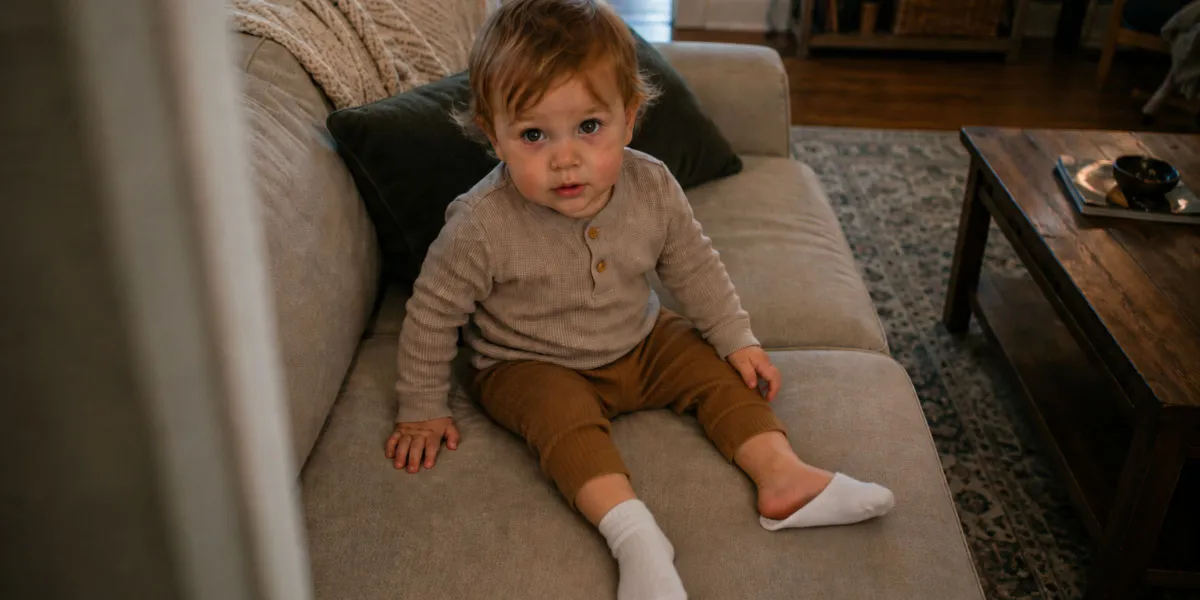
From the moment my grandson was born, she insisted on keeping little socks on him no matter where we were. At home. During family dinners. Even on the hottest summer afternoons, when every other baby was happily kicking their bare feet.
At first, I barely noticed.
Babies wore socks. They wore hats indoors, too, according to half the older women in our family. When Asher was a newborn, my mother once scolded me for letting him sleep without booties in July.
“You want him catching a chill?” she had said.
“Mom, it is 90 degrees outside,” I told her.
“A chill doesn’t care about the weather.”
So when Sandy kept socks on Bryce, I shrugged it off as new-mother caution. Some mothers checked breathing every five minutes. Some boiled pacifiers after one fall on the rug. Some carried little thermometers in their purse.
Sandy, I assumed, had socks.
But everyone else did.
It started at one of our family dinners when Bryce was about two months old. My sister Talia had come by with her husband, Dean, and their daughter, Rhea.
The house smelled like roasted chicken and lemon potatoes, and Asher was trying to balance Bryce against his shoulder while stealing bites from his plate.
Bryce wore a little striped onesie and pale blue socks.
Talia leaned over and tickled his belly. “Oh, look at him. Isn’t he too hot?”
Sandy’s hand moved before her face did. She reached down and touched one sock as if checking that it was secure.
“He’s fine,” she said, smiling.
Rhea, who had recently become obsessed with babies, crouched beside Asher’s chair. “Why is he always wearing socks?”
Sandy’s smile held, but only barely. “Because his feet get cold.”
“It’s July,” Dean said with a laugh.
Asher gave him a look. “Dad jokes are supposed to be funny, Uncle Dean.”
Everyone chuckled, and for a moment, the subject passed. But I saw Sandy bend over Bryce, her fingers brushing the sock elastic at his ankle.
Another time, one of my neighbors, Francesca, stopped by with a peach cobbler and leaned over Bryce’s stroller.
“Oh, come on… let Grandma see those adorable little toes.”
She said it playfully, the way women do around babies, as if babies belong to everyone for a few seconds.
Sandy’s expression changed so quickly that I might have missed it if I hadn’t been looking right at her.
Her eyes sharpened. Her mouth tightened. Then she forced a smile, gently pulled the sock back into place, and quickly changed the subject.
“Luna, do you still want me to bring the salad on Saturday?”
Francesca blinked, then looked at me.
I pretended not to notice.
That became the pattern.
People kept asking the same questions.
“Isn’t he too hot?”
“Why is he always wearing socks?”
Every single time, my daughter-in-law would force a smile, gently pull the sock back into place, and quickly change the subject.
If one started slipping off, she’d fix it before anyone had the chance to look.
I never said anything out loud.
But deep down… I thought she was being ridiculous.
That is not a flattering thing to admit.
I wish I could say I was patient and understanding from the start. I wish I could tell you I respected her instincts without judgment because she was Bryce’s mother, and mothers know things other people do not.
Instead, I grew irritated.
The irritation came slowly, then settled in like dust.
It bothered me when Sandy dressed Bryce in thick socks for afternoon visits, even when the sun had turned my kitchen windows bright white with heat.
It bothered me when she tucked his feet under a blanket in the stroller at the park, while other babies waved bare toes in the air. It bothered me most when she acted as if nobody noticed.
One Sunday, after Sandy and Asher left, I stood at the sink, rinsing the plates too hard.
“She’s protective,” my husband, Callum, said from the table.
I glanced over my shoulder. “Protective is one thing.”
“Luna.”
“What?” I snapped. “I didn’t say anything.”
“You didn’t have to.”
I shut off the water. “You don’t think it’s strange?”
Callum leaned back in his chair. “Lots of things are strange with first babies.”
“Not like this.”
He sighed. “Ask her, then.”
“And make her feel judged?”
“You already do.”
That stung because it was true.
So I kept quiet.
I brought it up once with Asher when he came over alone to fix the loose handle on my pantry door.
He was kneeling on the floor with a screwdriver in his hand, and I stood beside him pretending to sort coupons.
“Asher,” I said carefully, “is everything all right with Bryce?”
He looked up. “Of course. Why?”
“I mean, with his health.”
“He’s perfect.”
“And Sandy?”
His smile faded a little. “What about her?”
I hesitated. “She seems anxious.”
“She’s a new mom.”
“She never lets anyone see his feet.”
The screwdriver stopped turning.
For one second, his face went completely still. Then he looked back at the cabinet.
“Mom, don’t start.”
“I’m not starting. I’m asking.”
“No, you’re circling.”
“Asher.”
He stood, taller than me now, in a way that still surprised me. “Sandy is doing her best. Bryce is healthy. Please don’t make this into something.”
His tone was not angry, exactly. It was tired. And behind the tiredness, there was something else I could not name.
I backed off.
But the questions stayed.
Then came the afternoon that changed everything.
Sandy came over with the baby, just like she often did. Asher was at work, and she said she needed to get out of the house for a bit.
Her hair was pulled into a messy bun, and she looked more worn out than usual, with faint shadows under her eyes.
“Rough night?” I asked as I opened the door.
She smiled weakly. “Bryce decided sleep was offensive.”
I laughed and reached for him. “Come here, my poor little rebel.”
Bryce came to me happily, his warm little body sinking against my chest. He smelled like baby lotion and milk.
He had started giggling at the silliest things by then. A spoon tapping the table. My fake sneezes.
Callum’s reading glasses sliding down his nose.
We sat in the kitchen drinking coffee while my grandson happily kicked his little legs in my lap as she unpacked the diaper bag.
He wore a yellow romper that day, soft and bright as a daffodil, and white socks with tiny gray stars. His legs pumped with joy while I bounced him gently on my knees.
“Well, someone is in a better mood than his mother,” I said.
Sandy glanced up from the diaper bag. “He always saves his charm for you.”
“That’s because I’m fun.”
“You gave him a lemon slice last week.”
“He made one funny face and survived.”
She laughed, and for a moment, she looked like the young woman I had hoped to know better.
Not just my son’s wife.
Not just Bryce’s mother. Sandy. A tired, sweet, guarded woman who sometimes laughed before she remembered to be careful.
Then her phone rang.
She glanced at the screen and frowned.
“I’m so sorry,” she said. “I need to take this.”
“Go ahead,” I said. “We’re fine.”
She stepped outside onto the patio, quietly closing the sliding door behind her.
I could still see her through the glass, pacing back and forth while she talked.
Her shoulders were tight. One hand pressed the phone to her ear while the other rubbed the side of her neck.
She turned away from the window, then turned back.
Her mouth moved quickly, but I could not hear the words.
A few moments later, my grandson started giggling and kicking his feet.
“Are you showing off for me?” I asked, smiling down at him.
He squealed and kicked harder.
One of his tiny socks slowly began sliding off.
At first, I only stared.
The white fabric bunched at his heel, then slipped lower with every happy little kick. My hand hovered near it out of habit, because I had watched Sandy do that exact motion so many times.
Pull the sock up. Smooth the elastic.
Hide the foot.
For months, I’d watched my daughter-in-law rush to pull those socks back on before anyone could get a proper look.
This time… there was nobody to stop me.
I looked toward the patio.
Sandy was still on the phone, her back half-turned, her face tense. She did not look in my direction.
Bryce kicked again, delighted with himself.
The sock slid past his heel.
I knew I should have pulled the sock back up. Instead… I let it slip all the way off.
It landed on my kitchen floor, small and soft and harmless.
For one breath, I did nothing.
Then I looked down.
And the moment I saw my grandson’s tiny foot… I finally understood why my daughter-in-law had spent months making sure nobody else ever did.
At first, my mind refused to understand what my eyes were seeing.
Bryce’s little foot rested against my palm, warm and impossibly small. His toes curled and stretched, unaware of the storm gathering inside me.
Along the outside of his right foot was a mark, dark and uneven, shaped almost like a tiny crescent moon.
I stopped breathing.
It was not the mark itself that shook me. Babies were born with marks all the time. Stork bites. Birthmarks. Little patches that faded or stayed. I knew that.
But this one was familiar.
Too familiar.
My thumb hovered over it, but I did not touch it. My stomach tightened so hard I almost gasped. Bryce looked up at me and smiled, all gums and innocence, while my heart pounded against my ribs.
Behind the glass door, Sandy turned.
I fumbled for the sock.
By the time she slid the door open, I had it halfway back on, but my hands were clumsy. I could feel her eyes on me before I looked up.
“Luna?”
Her voice was quiet, but it carried something sharp beneath it.
“I’m sorry,” I whispered.
She froze.
The color drained from her face so quickly that she looked ill. Her phone was still in her hand.
Her other hand gripped the back of a kitchen chair.
“You saw,” she said.
It was not a question.
I swallowed. “The sock slipped off.”
Her eyes filled with tears at once. “I knew this would happen.”
“Sandy, I didn’t mean to upset you.”
“Yes, you did,” she replied, and her voice cracked. “Maybe not like this, but you wanted to know. Everyone wanted to know.”
Bryce became startled at the sound of her voice and whimpered. I pulled him closer, but Sandy stepped forward.
“Give him to me.”
I did, slowly.
The moment Bryce was in her arms, she sank into the chair and pressed her cheek to his hair. She rocked him even though he had already calmed. Her breathing came unevenly, like she was trying to keep herself from breaking in my kitchen.
I stood there uselessly with the little sock still pinched between my fingers.
“Sandy,” I said gently, “is he sick?”
She lifted her head. “No.”
“Is he hurt?”
“No.”
“Then why hide it?”
Her laugh was small and bitter. “Because people don’t just look, Luna. They talk. They ask questions. They decide what things mean before you get a chance to explain.”
I sat across from her, my knees suddenly weak.
“Then explain it to me.”
She wiped one eye with the heel of her hand. “You won’t believe me.”
“I want to.”
For a long moment, she stared at me as if deciding whether my words were worth anything. Then she reached down and eased Bryce’s sock off completely.
The crescent mark sat there on his soft skin.
“My mother has this,” she said. “Same place. Same shape.”
I blinked. “Your mother?”
“And my grandmother had it too. It skips around sometimes, but it’s in my family.”
She looked at Bryce’s foot with an expression that was part love and part fear. “When he was born, I cried when I saw it. Not because I was ashamed. But because it was the first thing about him that felt like mine.”
My throat tightened.
“Sandy, that’s beautiful.”
She shook her head. “It should have been.”
I waited.
She pulled Bryce closer. “When Asher saw it, he smiled. He said, ‘Look at that. He has your moon.’ I thought everything was fine.”
My son’s voice seemed to echo in the room, warm and proud.
He has your moon.
“Then why hide it?” I began.
Sandy’s face hardened, but the tears kept coming. “Because three days after we came home from the hospital, your sister Talia came over.”
I sat straighter. “Talia?”
“She brought soup. She held Bryce. One of his socks slipped off, and she saw the mark.” Sandy looked at me. “She went quiet. Then she asked if anyone in Asher’s family had anything like that.”
My stomach dropped.
“I told her it came from my side,” Sandy continued. “She smiled and said, ‘Of course.’ But it wasn’t a warm smile. It was the kind of thing people give when they’ve already decided you’re lying.”
“What did she say?”
Sandy’s mouth trembled. “She told Asher privately that birthmarks like that were strange. She said it was odd he didn’t look much like him yet. She said women had fooled men for less.”
“No,” I breathed.
“She didn’t say it in front of me. I heard them from the hallway.”
I covered my mouth.
Sandy looked down at Bryce, stroking his cheek with one finger. “Asher defended me. He told her to leave. He said he trusted me. But after that, I saw the doubt spread anyway. Not in him, exactly. Around him. In the family. In the looks. In the questions.”
The kitchen seemed to tilt around me.
All those little comments. All those smiles. All those questions about socks.
I had thought we were teasing a nervous mother, but maybe every word had landed like an accusation.
“I didn’t know,” I said, ashamed of how small it sounded.
“No one asked to KNOW,” Sandy answered. “They asked to SEE. There’s a difference.”
That struck me harder than anger would have.
I thought of every time I had judged her in silence.
Every time I had rolled my eyes after she left. Every time I had wondered why she could not simply relax and let us see her baby’s toes.
I had not once wondered what she was protecting him from.
Or herself.
“I’m sorry,” I said, and my voice broke. “I am so sorry.”
Sandy looked away.
I leaned forward. “I should have trusted you. I should have trusted that you had a reason, even if I didn’t understand it.”
She pressed her lips together. “Do you know what hurt the most?”
I shook my head.
“You were the one I wanted to tell.”
Those words undid me.
“I kept thinking, maybe Luna will ask me privately,” she said. “Maybe she’ll say, ‘Sandy, is there something you need from me?’ But you never did. You watched me struggle, and you judged me from across the room.”
Tears slipped down my cheeks.
“You’re right,” I admitted. “I did.”
Her eyes returned to mine, guarded but listening.
“I was so busy thinking I knew what a grandmother deserved,” I continued, “that I forgot what a mother deserves. Respect. Room. Trust.”
Bryce babbled softly, his tiny fingers grabbing Sandy’s necklace.
I reached across the table but stopped before touching her hand. “What can I do now?”
Sandy looked at my hand. After a moment, she placed hers over it.
“Don’t make me explain this to everyone like I’m on trial.”
“I won’t.”
“And don’t let them do it either.”
I nodded. “They won’t.”
That evening, I called Asher and asked him to come over with Sandy and Bryce for dinner the next Sunday. Then I called Talia.
She answered cheerfully. “What’s up?”
“We need to talk about what you said after Bryce was born.”
Silence.
Then, “Luna, I was only concerned.”
“No,” I said. “You planted suspicion in my son’s home. You made Sandy feel watched when she should have felt loved.”
“That’s not fair.”
“What wasn’t fair was making a new mother hide her baby’s feet because our family forgot its manners.”
She tried to argue, but I did not let her soften it into a misunderstanding. By the time we hung up, my hands were shaking, but my heart felt steadier than it had in months.
On Sunday, Sandy arrived with Bryce on her hip and Asher beside her. She looked nervous. I did not blame her.
During dinner, Bryce kicked in his high chair, happy as ever. One sock slid down.
The room went quiet for half a second.
I stood, walked over, and picked it up. Then I set it on the table.
“He’s warm enough,” I said calmly. “Let the boy enjoy his feet.”
Asher looked at me, and something in his face softened.
Sandy’s eyes shone, but she smiled.
Bryce kicked again, his little crescent mark in full view.
Nobody asked a question.
Nobody made a joke.
And near the end of the meal, Sandy finally said, “My family calls it the moon mark.”
Talia lowered her eyes. “It’s lovely.”
Sandy held my gaze from across the table. “It is.”
That was when I understood the real secret had never been Bryce’s foot.
It was the pain Sandy had been carrying alone, while the rest of us mistook her fear for foolishness.
And from that day on, when I held my grandson, I did not look at that tiny mark as something hidden.
I looked at it as a reminder.
Some wounds are not on the skin. Some are made by whispers, doubts, and the people who should have known better.
And sometimes, the first step toward healing is as small as a baby’s sock falling to the floor.