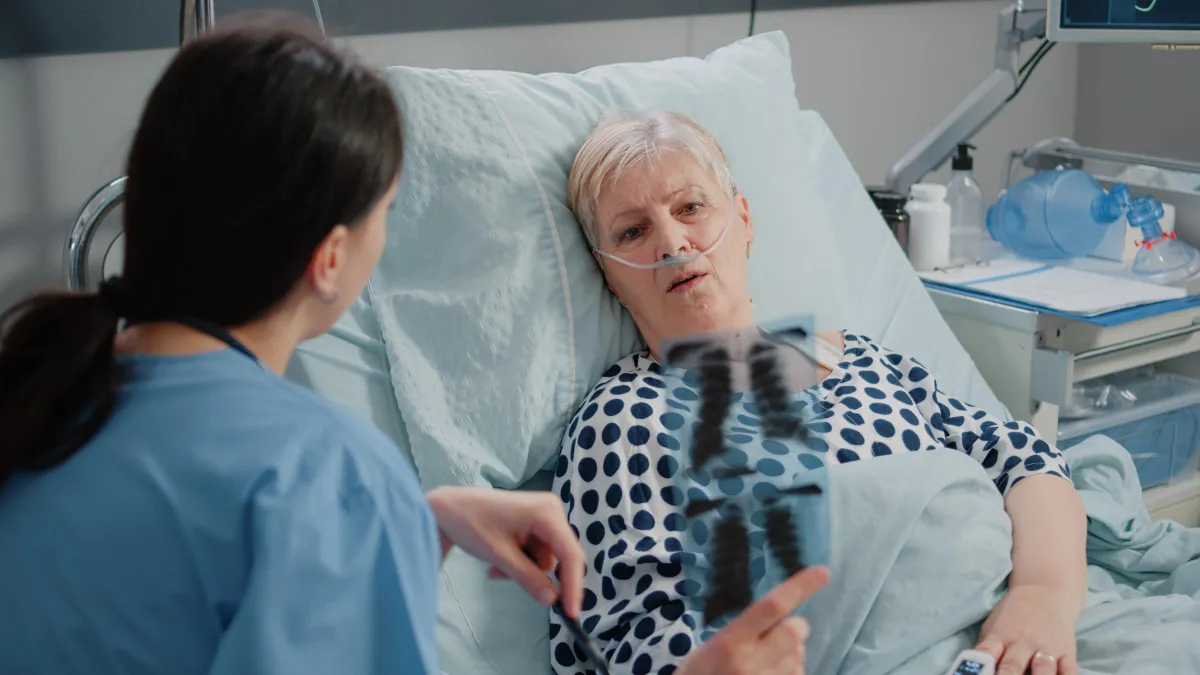
I believed my husband was visiting his recovering mother while I paid for her care. Then a doctor called me directly, and everything started falling apart.
That morning, our kitchen smelled like cinnamon toast and Sunday, the way it always did when my husband, Michael, was home. I had spent fifteen years building a quiet life with him, the kind of life that fit like a soft sweater.
When my mother-in-law, Patricia, had her stroke three months ago, I thought our love would only grow stronger through the storm.
The first hospital visits, we made together.
I remembered holding Patricia’s frail hand while Michael adjusted her pillow, his eyes glassy with worry.
“Thank you for being here, honey,” he whispered to me in the corridor. “I couldn’t do this without you.”
The first hospital visits, we made together.
“She’s my family, too, Michael. Of course I’m here.”
At home that night, he hugged me longer than usual. “You’re a lifesaver. Truly.”
I believed every word.
***
For a few weeks, things felt almost tender, the way grief sometimes pulls couples closer. I packed Patricia’s favorite lavender lotion in a tote, bought soft socks, and even started knitting her a blanket in pale yellow.
Michael watched me from the doorway with a strange, unreadable expression.
“What?” I asked, smiling.
“Nothing. Just lucky, I guess.”
Then the phone calls started.
“You’re a lifesaver. Truly.”
He took them in the garage, in the bathroom, once in the car with the windows up while I waited on the porch with two coffees going cold.
“Work stuff,” Michael told me, sliding back inside. “You know how it is.”
“You’ve been taking a lot of work calls lately.”
“It’s a busy quarter, babe.”
I let it go. I always let it go.
One evening, Michael came back from the hospital with his shirt collar smelling faintly of perfume that wasn’t mine. I told myself it was a nurse, or a visitor in the elevator, or my imagination running ahead of my heart.
“How’s Patricia today?” I asked, setting the table.
“You’ve been taking a lot of work calls lately.”
“Tired. The doctors said she needs absolute peace right now.”
“I’d like to come tomorrow. I miss her.”
Michael paused, fork halfway to his mouth.
“Actually, honey, about that.” His voice slid into something smoother, careful. “From now on, I think it’s better if I go alone. Mom needs peace. The drive is long. Too many visitors stress her out.”
“But I’m not just a visitor, Michael. I’m her daughter-in-law.”
“I know, I know.” Michael reached across the table and squeezed my hand. “Trust me. This is what’s best for her.”
I nodded slowly, swallowing the small, sharp thing that had begun to lodge itself behind my ribs.
That night, lying beside Michael in the dark, I listened to his breathing and felt, for the very first time, the thinnest crack running through the foundation of our marriage.
“From now on, I think it’s better if I go alone.”
***
The next morning, I packed a small bag of Patricia’s favorite tea and her reading glasses. I waited by the door with my coat already on.
“Michael, I’m coming with you today.”
He paused at the mirror, adjusting his tie a little too carefully. “Sweetheart, we talked about this. The doctors said that too many visitors stress her out. Let me handle it.”
“Ah, all right.”
He turned and kissed my forehead, the way he always did when he wanted a conversation to end. “And you’re an angel for caring. But the drive is brutal, and you’ve been exhausted. Let me carry this one for you.”
I let him go. I always let him go.
“Michael, I’m coming with you today.”
That afternoon, I wrote another check for three thousand dollars and slid it across the kitchen counter.
“The rehab wing again?” I asked Michael.
“They’re charging us for the physical therapy now. Insurance won’t touch it.”
“Michael, that’s the fourth check this month.”
He cupped my face in his hands like I was something precious. “You’re saving her life. You know that, right? My mother is going to walk again because of you.”
I wanted to believe him. I needed to believe him.
But that night I found a receipt in his jacket pocket for a restaurant I’d never heard of, sixty miles in the wrong direction from the hospital. And the new perfume on his collar, something sharp and floral that wasn’t mine.
I wanted to believe him.
***
The next day, I called the hospital directly. A young nurse answered.
“I’d like to check on Patricia in the rehab wing, please. This is her daughter-in-law.”
There was a long pause. “Ma’am, no one has visited her today. Are you sure you have the right ward?”
The dial tone hummed against my ear.
My thumb stayed pressed on the red button long after the screen had dimmed.
In my other hand, the shirt I had been folding sagged loose, the collar slipping over my fingers and pooling at my wrist like something already abandoned.
That evening, I tried to ask him, Michael, the way I always did.
“Are you sure you have the right ward?”
“Michael, when did you last see your mother?”
“This morning, honey. Why?”
“The nurse said no one visited today.”
He laughed. “Babe, those nurses rotate every twelve hours. Half of them don’t know which patient is which. The doctors specifically asked me not to bring anyone else right now. You have to trust me.”
“I do trust you.”
I said it like a prayer. Like if I said it out loud, it would become true again.
Three days later, Michael zipped up his suitcase by the bed.
“Three-day conference in Denver. I’ll check my phone whenever I can.”
“Tell your mom I love her.”
“Always do.” Michael kissed me and was gone before the coffee cooled.
“Michael, when did you last see your mother?”
That afternoon, my phone rang while I was folding his shirts. The number wasn’t saved.
“Is this Patricia’s daughter-in-law?”
“Yes, who is this?”
“This is Dr. Hensley. I’ve been trying to reach Michael for hours. His phone goes straight to voicemail. Your number was listed as Patricia’s secondary emergency contact.”
My fingers stilled on the collar in my hand. “What’s happening? Is Patricia all right?”
“Her condition has worsened significantly. You need to come now. And ma’am, there are some things we need to discuss when you arrive. Things about her care.”
“What things?”
“Please. Just come.”
I grabbed my keys, my purse, and my coat in one motion.
“What’s happening? Is Patricia all right?”
As I sped down the highway toward a hospital I hadn’t seen in a month, I realized I had no idea what had actually been happening inside those walls. And I was about to find out alone.
My tires screeched into the hospital parking lot before I even remembered turning off the highway.
I ran through the sliding doors, past the front desk, past a janitor with his mop, my coat half off one shoulder.
A nurse stepped directly into my path before I reached the elevator. She was small, gray at the temples, and she pressed something folded into my palm.
“I’m the one who called you,” she whispered. “Read this immediately. Your husband is lying to you.”
My fingers wouldn’t cooperate at first.
The note inside read: “Go to Room 120. I’ll show you the security camera footage. Please stay calm and don’t tell anyone.”
“Read this immediately. Your husband is lying to you.”
I followed her down a side hallway. She unlocked a small office and gestured for me to sit.
A monitor flickered to life in front of me.
“I need you to understand something before I press play,” she said. “What I’m about to show you, I should have shown you weeks ago. Hospital administration finally allowed me to copy the footage after Patricia filed a complaint.”
“Just play it,” I whispered.
The footage began.
There was Michael in the rehab wing corridor, but he wasn’t walking toward Patricia’s old room. He was holding a woman’s hand. A younger woman, with a clear curve at her belly under a soft sweater.
He kissed her at the elevator like he had kissed me on our wedding day.
“I need you to understand something before I press play.”
“No,” I breathed.
The nurse clicked to a second file. A different date. The administrative office.
Michael was signing papers across a desk.
“What is that?” I asked.
“Discharge papers. He stopped paying. Once the rehab program discharged Patricia, she was transferred to the hospital’s charity ward on the fourth floor.”
I gripped the edge of the desk. “That can’t be right. I gave him money. Every week. For the bills.”
“I know,” she said gently. “I checked the billing records myself. Nothing has come into Patricia’s account in almost a month.”
My vision narrowed to a single bright point on the screen.
“Who is she?” I whispered.
“That can’t be right. I gave him money. Every week.”
“Her name is on the visitor logs. He introduced her as his fiancée. She’s twenty-three weeks pregnant. Patricia found paperwork in his bag.”
“How do you know about her?”
The nurse folded her hands. “Patricia asked me to help her. She tried to call you four times from the ward phone. He blocked the number on your line. She had me write you a letter. He intercepted the mail at your house.”
“She knew,” I said, and my voice cracked.
“She knew. She has been trying to warn you since the day he moved her. I started documenting everything two weeks ago. I didn’t know how to reach you until today.”
“She’s twenty-three weeks pregnant.”
I covered my face with my hands. I thought of every hug, every grateful kiss on my forehead, every envelope of cash I had pressed into his palm, believing it was keeping his mother alive.
“My husband used me,” I said. “He used me to pay for her.”
“Yes,” the nurse said softly.
I lowered my hands. My face felt like stone. “Where is Patricia right now?”
“Fourth floor. Bed by the window. She asked about you this morning.”
“Does she know I’m here?”
“Not yet.”
I stood up slowly. The chair scraped against the tile. “Take me to her. Right now.”
“He used me to pay for her.”
I tucked the note deep into my coat pocket like a piece of evidence I would never let go of.
Two women had been left behind by the same man, and I was about to walk into the room of the one who had been trying, against everything, to save me.
I found Patricia in a crowded shared ward, her thin hand trembling as she reached for mine.
“I tried to tell you,” she whispered, tears sliding into her hair. “Every time. He took my phone.”
“I know now,” I said, squeezing her fingers. “I’m here. You’re not alone anymore.”
“He stopped paying weeks ago. They moved me here. I was so ashamed.”
“You have nothing to be ashamed of.”
I stepped into the corridor and called my lawyer with steady hands I didn’t recognize as my own.
“Every time. He took my phone.”
“Freeze the joint accounts today. Draft the papers. And I need Patricia transferred under my name as guarantor by morning.”
“Consider it done.”
That night, Michael walked through our front door, still wearing the smile he used like a key. I was waiting in the entryway with the note, a flash drive, and a folder thick with paperwork.
“Honey, what’s all this?”
“This is the part where you stop talking.”
His smile faltered.
“Honey, what’s all this?”
“I saw the footage, Michael. I saw her. I saw the discharge papers. I saw your mother in a charity ward while you took my money for an apartment.”
“Baby, let me explain.”
“No.”
He took a slow step closer and reached for my face, the same way he had cupped it in the kitchen the afternoon I wrote him that three-thousand-dollar check.
“Baby, let me explain.”
“Sweetheart, look at me. You know me. After fifteen years, you really think I would do that to my own mother? To you? Whoever showed you that video edited it. Please. Think about Mom. Think about what she would want you to do right now. She would want you to listen to me.”
His fingers brushed my cheek.
For one breath, my body remembered how to lean in. Fifteen years of muscle memory pulled at me like a tide.
Then I stepped back. I lifted my hand and moved his away from my face, finger by finger, the way you remove something that has already grown cold.
Fifteen years of muscle memory pulled at me like a tide.
“Don’t you ever say her name to me again like she’s a card you can play.”
“Honey, please.”
“I am done letting you go anywhere I should have been standing.” I handed him the folder. “Patricia is safe. She’s under my care now. You’ll be hearing from my attorney by Monday.”
“You can’t do this to me.”
“I’m not doing anything to you. I’m doing it for her. And for me.”
I closed the door behind him without raising my voice.
“You can’t do this to me.”
Weeks later, I sat beside Patricia in a sunlit recovery room, helping her trace letters on a notepad. She laughed for the first time since the stroke, and the sound undid something tight in my chest.
The truth had cost me a marriage.
It had given me back a mother, and the woman I used to be before I learned to doubt her.