For 15 years, Robert called gifts “wasteful.” Then he gave me a luxury handbag at my birthday party, and everyone gasped. I smiled until I felt a folded slip inside the lining, a phone number with no name, and realized the beautiful bag had belonged to another woman before it reached me… forever.
Robert never bought me gifts.
Not once in 15 years.
No flowers. No cards. No birthday necklace tucked into a velvet box. No anniversary dinner at the kind of place where waiters folded napkins over your lap and called you Ma’am.
Robert never bought me gifts.
***
“Flowers die,” he always said.
“Cards get tossed.”
“Gifts are money leaving the house.”
He said it so often that, after a while, I started saying it with him in my head before he even opened his mouth.
Still, on the morning of my 35th birthday, I stood in our bedroom wearing my good navy dress and watching Robert knot his tie with shaking fingers.
That was the first strange thing.
Robert did not shake.
“Gifts are money leaving the house.”
He balanced our checkbook every Sunday with a blue pen, clipped coupons with the focus of a surgeon, and once drove 12 miles back to a grocery store because a cashier had charged us twice for canned tomatoes.
But that morning, he dropped his tie clip twice.
“Big day?” I asked.
His eyes met mine in the mirror, then slid away.
“For you, Elle.”
He only called me Elle when he was nervous or tender, and lately, he had been too exhausted to be either.
He only called me Elle when he was nervous.
***
For three months, he had been leaving before sunrise and coming home after midnight. His shirts smelled faintly of bleach and soap that was not ours. His knuckles were scraped.
Once, I found a red scratch along the inside of his wrist, thin and angry, like someone’s fingernail had caught him.
When I asked, he always gave me the same answer.
“Nothing happened.”
That was the second strange thing.
Robert did not lie well.
That was the second strange thing.
***
At seven that night, my sister Lila filled our dining room with balloons, cheap paper streamers, and enough noise to make our little house feel like a restaurant.
My mother brought a casserole. Our neighbors came with wine. Someone lit candles on a chocolate cake.
Robert stood near the kitchen doorway, one hand in his pocket, watching me like he was waiting for a verdict.
After everyone sang, he stepped forward and set a cream-colored box in front of me.
Robert stood near the kitchen doorway.
The room went quiet.
Not polite quiet. Hungry quiet.
The box had a gold logo stamped across the lid.
Lila sucked in a breath. “Elaine.”
I stared at it.
Robert cleared his throat. “Open it.”
The box had a gold logo stamped across the lid.
My fingers slid under the lid. Tissue paper whispered as I pulled it back.
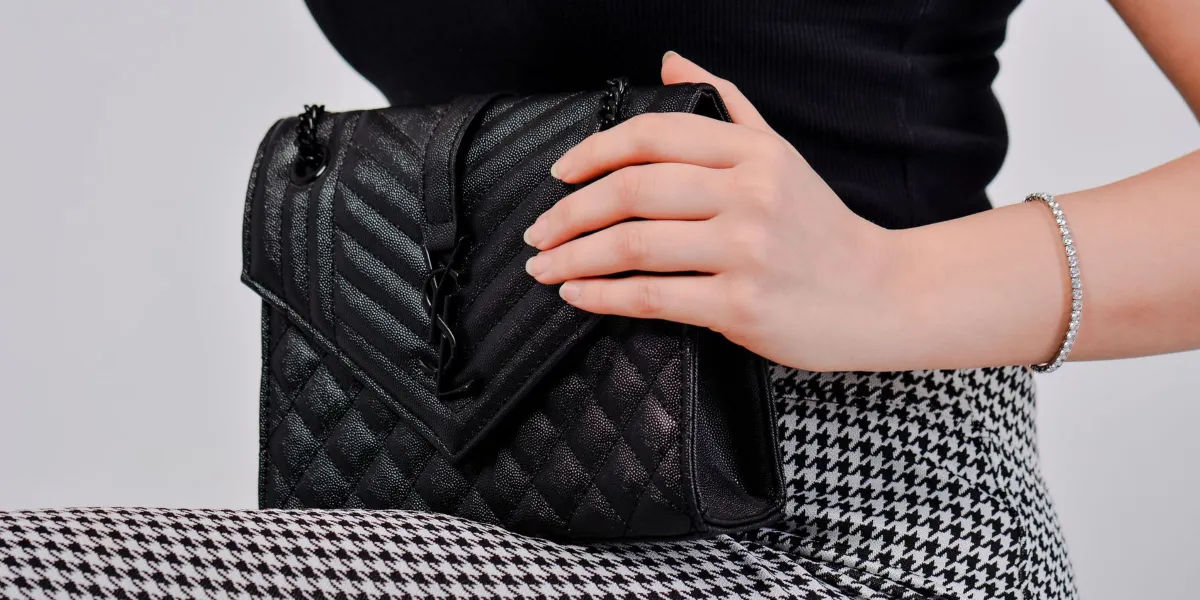
Inside was a glossy black luxury handbag with gold hardware and soft leather that caught the light like still water.
For one second, I forgot every practical speech Robert had ever given me.
Then I touched the handle.
The leather was warm from the room, but too soft. Not new soft. Used soft. The handle had a faint crease where another woman’s fingers had held it again and again.
I forgot every practical speech Robert had ever given me.
Lila leaned close and whispered, “That probably costs more than my car.”
Everyone clapped.
Robert smiled too wide.
“For my beautiful wife,” he said loudly.
My cheeks burned. I wanted to cry. I wanted to laugh. I wanted to believe the husband who had never bought me so much as a $5 bouquet had suddenly decided I deserved something beautiful.
“For my beautiful wife.”
Then my fingers brushed something stiff inside the lining.
A folded slip of paper.
I did not pull it out.
Not with everyone watching.
Instead, I smiled for photos while my stomach slowly turned cold.
My fingers brushed something stiff inside the lining.
***
Through dinner, Robert barely ate. Twice, his phone buzzed, and twice, he silenced it without looking at the screen. When I asked if everything was all right, he placed his hand over mine so quickly that my mother noticed.
“Rob,” Lila said, lifting her wineglass, “I have to say, I didn’t know you had it in you.”
A few people laughed.
Robert’s mouth tightened.
“Neither did I,” he said.
That should have sounded romantic.
It didn’t.
That should have sounded romantic.
***
After the last guest left and Lila carried the final trash bag to the curb, I took the handbag from the dining table and walked into the kitchen.
Robert was standing at the sink, staring at his own reflection in the dark window.
I reached inside the hidden pocket.
The folded paper came out small and thin, worn at the edges.
On it was a phone number.
No name. No message.
Just 10 digits written in careful blue ink.
On it was a phone number.
Robert turned around, and all the color left his face.
“Where did you get this?” I asked.
His throat moved. “Elle.”
“Do not Elle me. Where did you get this bag?”
He gripped the counter behind him. “I can explain.”
“Then explain.”
“Where did you get this?”
He looked toward the hallway, then back at me, as if someone else might step in and save him.
No one did.
“The bag belonged to someone else,” he said.
The kitchen clock ticked over the stove.
“Another woman?”
He closed his eyes.
That was answer enough.
“The bag belonged to someone else.”
My chest tightened so hard I could barely breathe. Three months of late nights, strange smells, scratches, unanswered questions, and now another woman’s luxury handbag sitting on my kitchen table like evidence.
“How long?” I whispered.
His eyes snapped open. “No. Elaine, no.”
“HOW LONG?”
“It’s not what you think.”
I laughed once, but nothing about it felt funny. “Men only say that when it is exactly what we think.”
“It’s not what you think.”
His face crumpled in a way I had never seen before.
“I was trying to do one good thing,” he said.
“With another woman’s purse?”
He looked at the note in my hand.
“It’s already too late to change it.”
The words went through me like ice water.
“What does that mean?”
“It’s already too late to change it.”
His mouth opened, but no sound came out.
The phone number stared up from my palm.
I thought of the scratches. The late calls. The way he had started showering before touching me when he came home. The floral scent I had caught once on his jacket, soft and powdery, not mine.
My hand shook as I picked up my phone.
“Elaine, wait.”
“No.”
“Please.”
I dialed before fear could stop me.
I thought of the scratches.
The call rang twice.
A woman answered. “Millbrook Hospice Services, this is Anna speaking.”
I froze.
Robert sank into a chair.
“Hospice?” I repeated.
“Yes, ma’am. How can I help you?”
I looked at Robert. His elbows were on his knees, both hands covering his face.
“My name is Elaine. I found this number inside a handbag.”
A woman answered.
There was a pause.
Then Anna’s voice softened. “Elaine.”
I swallowed. “You know me?”
“Not personally. But Margaret asked me to expect your call.”
My knees weakened. Robert stood too quickly. The chair legs scraped the floor.
“Who is Margaret?” I asked.
Anna breathed out slowly. “She was one of our patients. She passed away two weeks ago.”
The kitchen tilted.
“Who is Margaret?”
I gripped the edge of the table.
“Why would her handbag be in my house?”
“Because she left it to you.”
I looked down at the black leather bag, its gold clasp gleaming beneath our cheap kitchen light.
“I don’t understand.”
“Why would her handbag be in my house?”
“Margaret was very fond of your husband,” Anna said. “He worked evening shifts here. He helped with patient transport, cleaning rooms, supply carts, whatever we needed. Margaret said he was the kindest stubborn man she had met in years.”
Evening shifts. Cleaning rooms. Hospice.
I turned slowly.
“You were working there?”
Robert nodded once, unable to look up.
“Margaret was very fond of your husband.”
Anna continued, “Margaret had no close family left. She spoke often about wanting the bag to go to someone who would understand its value beyond money.”
“But she didn’t know me.”
“No,” Anna said gently. “But she knew how Robert spoke about you.”
My eyes burned.
“Really? What did he say?”
“But she didn’t know me.”
Anna was quiet for a moment, choosing her words. “That you liked yellow roses at grocery stores but never bought them for yourself. That you pretended not to care about birthdays, but always stayed up late the night before making other people’s cakes.”
My hand covered my mouth.
Robert knew those things.
He had noticed.
He just never acted like noticing mattered.
He had noticed.
“There’s a letter,” Anna added. “Margaret asked that you read it before you decide what kind of man your husband is.”
The line went silent except for her breathing.
I thanked her and ended the call.
Then Robert reached into his jacket pocket and pulled out an envelope.
It was addressed to me in the same careful blue ink.
Elaine.
“Margaret asked that you read it.”
***
My fingers trembled as I opened it.
Dear Elaine,
You do not know me, but I have heard your name every night for nearly three months.
Robert talked about you while mopping floors, while pushing my chair to the window, while pretending he was not tired enough to fall asleep standing up.
He said you made the best lemon cake in the county.
He said you hummed when you folded laundry.
Then I asked him what he had bought you.
He looked at the floor.
“I have heard your name every night for nearly three months.”
***
A man who can remember the way his wife hums should not make her feel invisible.
Your husband is not cheap because he does not love you.
He is frightened because he learned too young that money can disappear, homes can disappear, and fathers can cry where children can hear them.
But fear is a poor language for love.
“He learned too young that money can disappear.”
I am giving you my handbag because I carried it during the happiest years of my life. My late husband bought it for me after forty years of marriage. I told him it was too much. He said, “Some things are worth more than the money they cost.”
Let this be the beginning of something, not the end.
And Robert, if you are reading over her shoulder, buy the woman flowers.
They die. That is the point.
Margaret.
“Some things are worth more than the money they cost.”
***
By the time I finished, the words had blurred.
Robert was crying.
His shoulders shook, and the sound that came from him made him seem younger than 38.
“I was going to buy you one,” he said.
“A handbag?”
He nodded. “You stopped in front of that store window last spring. You touched the glass like you didn’t even know you were doing it. I saw the price and almost got sick.”
Robert was crying.
I remembered that day. I remembered walking away quickly, embarrassed that I had wanted something so foolish.
“I took the hospice job because I wanted to pay for it myself,” he said. “Not from savings. Just extra money. Money that wouldn’t touch the house or the emergency fund.”
“Why didn’t you tell me?”
“Because I knew you would say I didn’t have to.”
I sat across from him.
“Why didn’t you tell me?”
The kitchen smelled like extinguished candles and leftover coffee. The birthday balloons bobbed against the ceiling in the dining room, cheerful and cruel.
Robert rubbed both hands over his face.
“When I was nine, my father lost almost everything,” he admitted. “Bad investments. Stupid loans. Things my mother begged him not to do. We left our house with garbage bags full of clothes. One Christmas, there was nothing under the tree. Not even socks.”
I said nothing.
“One Christmas, there was nothing under the tree.”
He stared at the table. “I remember my mother putting bread back at the store because she was $3 short. I remember promising myself that when I had a family, nobody would ever feel unsafe because I wanted to buy something pretty.”
His eyes found mine.
“But I made you feel unloved instead.”
That was the truth neither of us could avoid.
“I made you feel unloved instead.”
For years, I had defended him to everyone.
Robert is practical.
Robert shows love differently.
Robert keeps us safe.
All of that was true.
So was the fact that I had spent 15 birthdays smiling over empty hands.
All of that was true.
“I knew you loved me,” I said.
He flinched.
“But sometimes I wanted to feel celebrated, Rob. Not expensive. Just chosen.”
He nodded, tears tracking down his face. “I know that now.”
“Do you?”
“Margaret asked me once what I was saving for.” His mouth twisted. “When I told her why, she gave me this.”
“I wanted to feel celebrated, Rob.”
I looked at the handbag.
It had crossed from one woman’s life into mine with a message neither Robert nor I could ignore.
Love could protect tomorrow.
But it could also starve today.
***
Three weeks later, I invited everyone back for dinner.
Lila arrived with wine and an apology already written across her face. My mother brought pie. Robert nearly backed out twice before I squeezed his hand under the table.
It had crossed from one woman’s life into mine.
Before dessert, I read Margaret’s letter aloud.
The room stayed quiet long after I finished.
Lila looked at Robert, her eyes wet. “I thought you were trying to show off.”
He gave a small, embarrassed shrug. “That would have been cheaper emotionally.”
A laugh moved through the room, soft and relieved.
For the first time, my family saw the man I had spent years trying to understand.
For the first time, I did too.
“That would have been cheaper emotionally.”
***
Months have passed since that birthday.
I still carry Margaret’s handbag, but not because of the logo. Her letter stays tucked inside the pocket where I first found the phone number.
Last Friday, Robert came home from work holding one yellow rose wrapped in clear plastic. Just one.
The price sticker was still on the stem, because of course it was.
“I know it will die,” he said.
I laughed until I cried.
Then I put it in water.
“I know it will die.”