The Lunch Tray
“Put it back. You didn’t pay for that.”
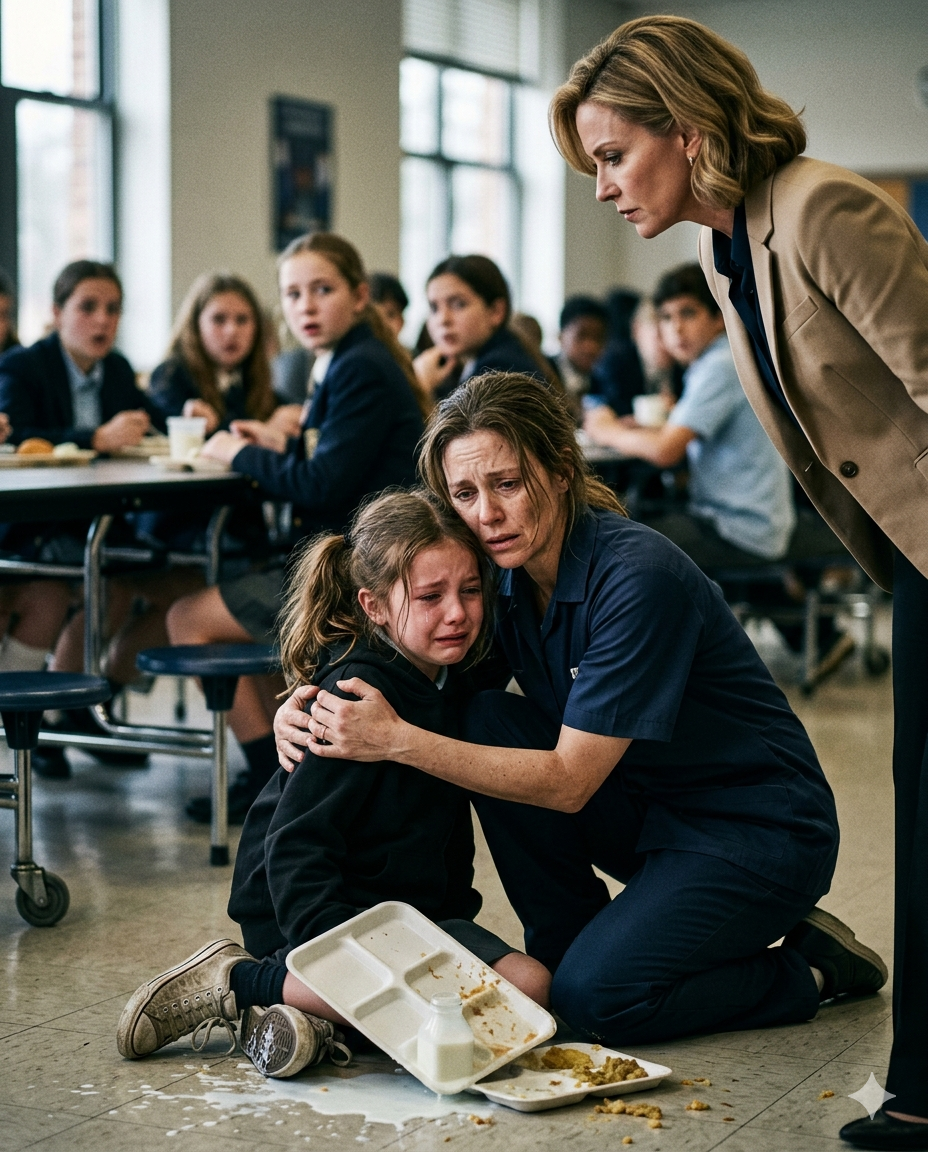
The whole school cafeteria went quiet when Pamela Reed slapped the lunch tray out of Maya Bennett’s hands.
Mashed potatoes hit the floor first. Then the carton of milk burst open across Maya’s sneakers. The little girl froze, her skinny shoulders shaking under a faded yellow hoodie two sizes too big.
“I did pay,” Maya whispered.
Pamela folded her arms, her diamond bracelet flashing under the cafeteria lights. “With what money? Your mother cleans houses for people like us.”
A few kids laughed.
Maya looked toward the double doors, praying her mother wouldn’t walk in and see it.
But Lena Bennett had already seen everything.
She stood near the entrance in her work uniform, holding a brown paper bag with Maya’s forgotten asthma inhaler inside. Her hands were red from cleaning chemicals. Her hair was tied back messy. She looked tired in a way no nap could fix.
Pamela turned and smiled coldly.
“Oh. Perfect. The maid is here.”
Lena walked forward slowly. “Don’t talk to my daughter like that.”
Pamela stepped closer, lowering her voice just enough to sound cruel, but loud enough for everyone to hear.
“Then teach her not to act like she belongs with my family.”
Maya’s face crumpled.
Lena swallowed the anger burning in her throat. She wanted to scream. She wanted to drag Pamela out of that cafeteria. But Maya was watching. So were a hundred children.
So Lena bent down, picked up the tray, and whispered, “Come on, baby. We’re leaving.”
Pamela laughed behind them.
“That’s what people like you do best. Leave quietly.”
Lena stopped.
For one second, everyone thought she would turn around.
But she didn’t.
She took Maya’s hand and walked out with tears in her eyes.
What nobody in that cafeteria knew was that Pamela Reed had just humiliated the one woman keeping her life from falling apart.
Three years earlier, Lena’s husband, Aaron, had died in a highway accident two weeks before Christmas. He left behind medical debt, a broken pickup truck, and a little girl who still asked why Daddy didn’t come home.
Lena cleaned offices at night, houses in the morning, and sometimes washed dishes at a diner on weekends. She told Maya they were “starting over,” but really, Lena was just trying not to drown.
The one good thing in their life was Ashford Academy.
It was a private school with polished floors, strict uniforms, and parents who drove cars that cost more than Lena’s yearly income. Maya had received a scholarship after her teacher noticed she could solve math problems two grades above her level.
Maya loved that school.
Lena feared it every day.
Because schools like Ashford welcomed poor children in brochures, but not always at lunch tables.
Pamela Reed was the president of the parents’ board. Her husband, Grant Reed, owned half the car dealerships in town. Their son, Tyler, was in Maya’s class.
Pamela had made it clear from the first week that Lena did not belong.
At pickup, Pamela would wrinkle her nose and say, “Cleaning supplies again?”
At fundraisers, she would hand Lena a broom instead of a donation sheet.
Once, during a parent meeting, Pamela said, “Some families bring resources. Others bring need.”
Everyone knew who she meant.
Lena never answered.
Not because she was weak.
Because she was hiding something.
After the cafeteria incident, Maya stopped talking in the car.
She stared out the window, gripping her inhaler like it was the only thing holding her together.
Lena parked outside their small rental duplex and turned off the engine.
“Sweetheart,” she said softly, “look at me.”
Maya didn’t.
“Did she hurt you?”
Maya shook her head.
“Then why are you crying?”
The girl’s lips trembled.
“Because she said we don’t belong there.”
Lena’s heart cracked.
She reached over and brushed milk from Maya’s shoelace.
“Listen to me. People who need to make others feel small are usually terrified of what’s inside them.”
Maya finally looked at her.
“What’s inside Mrs. Reed?”
Lena stared through the windshield.
Guilt.
Fear.
A secret with Pamela’s name on it.
But Lena only said, “Something sad.”
That night, Lena went to work cleaning the Reed house.
She had taken the job six months earlier under a different cleaning company. Pamela didn’t realize Lena was assigned to her home until the first day.
When she saw Lena standing at her door with a mop bucket, she smiled like she had won something.
“Well,” Pamela said, “this is appropriate.”
Lena wanted to quit on the spot. But the Reed house paid double. Maya needed medication. Rent was late. Pride couldn’t buy groceries.
So every Tuesday and Thursday evening, Lena cleaned the marble kitchen where Pamela hosted charity brunches.
That night, the house was unusually quiet.
Pamela was in the living room, arguing on the phone.
“I told you not to call here,” she snapped. “No, Grant can’t know. Do you understand me? If this comes out, I lose everything.”
Lena froze in the hallway with a laundry basket in her arms.
Pamela continued, her voice shaking.
“I paid you already. Stop threatening me.”
Lena backed away before Pamela saw her.
She didn’t want to know.
But the next week, she found out anyway.
While cleaning Grant Reed’s home office, Lena knocked a folder off the desk. Papers spilled across the rug. She knelt quickly to gather them.
Then she saw her husband’s name.
Aaron Bennett.
Her breath stopped.
There were old accident reports, insurance forms, and a handwritten note from Grant’s company lawyer.
Lena read one line before she could stop herself.
“Driver identified as P. Reed. Settlement withheld pending internal handling.”
Her fingers went numb.
Pamela Reed had been driving the SUV that killed Aaron.
Not a truck driver. Not a stranger. Pamela.
Lena stumbled back, clutching the edge of the desk.
For three years, Lena had believed Aaron died because of rainy roads and bad luck. She had blamed God. She had blamed herself for asking him to pick up medicine that night.
But Pamela had known.
Grant had known.
And they had buried the truth under money, lawyers, and silence.
Lena wanted to run to the police. She wanted to scream in Pamela’s perfect kitchen until the walls shook.
But then she saw another paper.
A payment record.
Monthly deposits made to an account under the name “Ashford Student Assistance Fund.”
The exact amount of Maya’s scholarship.
Lena sat down hard in Grant’s chair.
Pamela had taken Aaron’s life, hidden it, and then quietly paid for Maya’s school through a fake fund.
Not kindness.
Guilt.
The next morning, Lena called the county records office. Then the insurance company. Then the retired officer who had handled the accident.
Everywhere she turned, doors closed.
“Records sealed.”
“Case inactive.”
“No comment.”
Grant Reed had power in that town. Pamela had money. Lena had a cleaning uniform and a daughter who still cried at lunch.
So Lena waited.
Not forever.
Just long enough to gather proof.
For two months, she copied what she could safely access. Dates. Payments. Old reports. Repair invoices for Pamela’s SUV. A recorded voicemail from Pamela threatening the unknown caller.
But the pressure grew.
Pamela became crueler, like she could sense Lena knew something.
At the spring parent gala, Lena volunteered because scholarship families were “encouraged” to help. She served lemonade in the school courtyard while Pamela posed for photos near a banner about community kindness.
Maya stood beside Lena in a thrift-store blue dress, trying to disappear.
Then Pamela walked over with two board members.
“Lena,” she said brightly, “we need to discuss next year.”
Lena set down the pitcher.
Pamela smiled at Maya. “Scholarships are competitive. And frankly, this school needs families who reflect our standards.”
Maya’s eyes filled with panic.
Lena’s voice was low. “My daughter earned her place here.”
Pamela tilted her head. “Did she? Or did someone feel sorry for her?”
The words hit Maya like a slap.
“Mom,” Maya whispered, “can we go?”
Pamela leaned closer.
“That’s probably best. Before she embarrasses herself further.”
Something inside Lena finally broke.
“No,” Lena said.
The courtyard went silent.
Pamela blinked. “Excuse me?”
“I said no.”
Grant Reed stepped from the crowd, his face tight. “Lena, this isn’t the place.”
Lena turned to him. “Funny. You said the same thing when your wife killed my husband.”
Every sound vanished.
Pamela’s smile died instantly.
Maya looked up at her mother, confused.
“What?” she whispered.
Pamela’s face turned white. “How dare you.”
Lena’s hands shook, but her voice stayed steady.
“For three years, I thought Aaron died because of an accident. Then I cleaned your office and found his name in your files.”
Grant moved forward. “You need to stop talking.”
“No,” Lena said. “You stopped my life from making sense. You let my daughter cry for a father while your wife sat across from us at school meetings.”
Pamela’s lips trembled. “It was raining. He stepped out too fast. I didn’t mean—”
Grant grabbed her arm. “Pamela.”
But she pulled away.
“I didn’t mean to hit him,” Pamela cried. “I panicked.”
Maya covered her mouth.
Lena’s eyes filled with tears.
“You panicked?” she whispered. “My husband died alone on the road, and you panicked?”
Pamela looked around at the staring parents.
“I paid for the school,” she said desperately. “I made sure Maya got in. I paid every month.”
The words struck the crowd like thunder.
Maya stepped back from Pamela.
“You paid?” the little girl whispered.
Pamela nodded, crying now. “I was trying to help.”
Lena shook her head.
“No. You were trying to sleep at night.”
Grant’s voice hardened. “Enough.”
Then another voice came from behind him.
“No, Grant. It’s not enough.”
Everyone turned.
Mr. Ellis, the school principal, stood beside a woman in a gray suit. Lena recognized her immediately.
Dana Mercer.
The county investigator Lena had contacted three weeks earlier.
Grant’s face changed.
Dana stepped forward. “Mrs. Reed, Mr. Reed, we’ll need you to come with us and answer questions about evidence suppression, false reporting, and witness intimidation.”
Pamela began sobbing.
Grant looked at Lena like he could still scare her.
But Lena didn’t move.
For years, she had scrubbed floors in houses where people looked through her. She had swallowed insults so Maya could keep her scholarship. She had carried grief like a stone in her chest.
Now every parent in that courtyard knew the truth.
Pamela hadn’t been generous.
She had been guilty.
And Grant hadn’t protected his family.
He had protected his reputation.
Maya clung to Lena’s side.
“Mom,” she whispered, “did Daddy know?”
Lena knelt in front of her.
“No, baby. But I think he knows now that we didn’t give up.”
Maya cried into her mother’s shoulder.
Two weeks later, the Ashford board removed Pamela as president. Grant’s company became the center of a public investigation. Several sealed records were reopened.
The school offered Maya a permanent academic scholarship under her own name, not Pamela’s money.
At the next lunch period, Maya walked into the cafeteria holding a tray.
The same kids who had laughed before looked away.
Tyler Reed stood near the milk cooler, pale and quiet.
Maya hesitated.
Then a girl from her math class pulled out a chair.
“Sit with us,” she said.
Maya looked back at the cafeteria doors.
Lena stood there in her cleaning uniform, just for a second, watching.
This time, nobody laughed.
Nobody called her a maid.
Nobody told her to leave quietly.
Maya smiled through tears and sat down.
Lena turned to go, but Mr. Ellis stopped her.
“Mrs. Bennett,” he said gently, “we’d like to offer you a position here. Student support assistant. Full benefits.”
Lena stared at him.
“I don’t have a degree.”
He smiled. “No. But you know what it feels like when a child needs someone to stand beside them.”
Lena looked through the glass at Maya, laughing softly with her new friends.
For the first time in three years, breathing didn’t hurt.
That evening, Lena and Maya visited Aaron’s grave.
Maya placed a small folded napkin on the grass.
It was from the cafeteria.
On it, she had written three words in purple marker:
We stayed, Daddy.
Lena read it and cried.
Not because the pain was gone.
Because for the first time, it belonged to the truth.
And sometimes, justice doesn’t arrive loudly.
Sometimes it walks in wearing a cleaning uniform, holding a child’s hand, and refuses to leave.