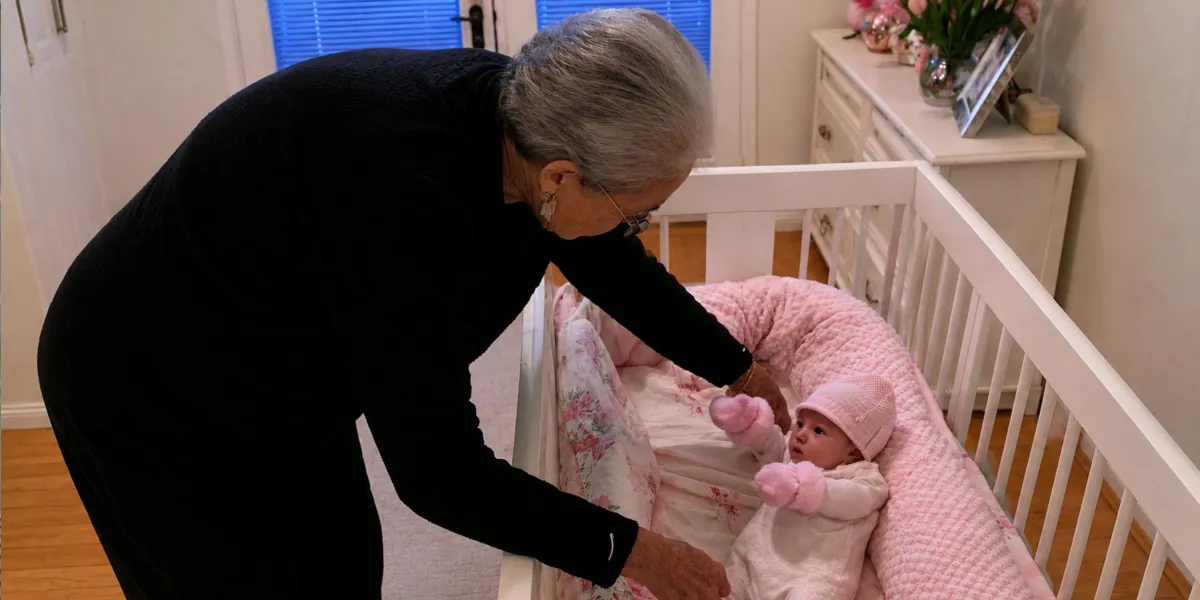
Every visit with Willow followed the same pattern: Nancy kept her close, covered, and just out of reach. Sienna told herself it was new-mother anxiety until a quiet moment at her own party revealed the truth behind months of distance.
The moment my daughter-in-law left the room, I finally picked up my granddaughter for the first time in her life.
I know I probably should not have.
Even now, thinking back on it, I can still feel the tiny weight of Willow in my arms, warm and soft against my chest. I can still hear the low hum of voices from my birthday party behind me, the clink of glasses, and the soft rustle of leaves in the backyard.
But before that moment, before everything changed, there had been six long months of watching my granddaughter from a distance.
Six months of smiling when I wanted to cry.
Six months of pretending I understood.
Willow was born in early spring, with a full head of dark hair and the smallest rosebud mouth I had ever seen. My son, Tristan, sent me a picture from the hospital the morning after she arrived.
“Mom, she’s here,” he said when he called.
His voice cracked on the last word, and I pressed my hand to my chest because I had not heard my son sound that happy in years.
“Oh, sweetheart,” I whispered. “Is Nancy okay?”
“She’s tired, but she’s okay. Willow’s perfect.”
Willow.
The name had been Nancy’s choice, and at the time, I thought it was beautiful. Gentle. Sweet. A name that sounded like something bending in the wind but never breaking.
I brought flowers to the hospital that afternoon.
Pale yellow tulips because Nancy had once mentioned liking them. I also brought a soft white blanket I had knitted during the last month of her pregnancy.
When I walked into the room, Tristan was sitting beside the bed, his hand resting on Nancy’s shoulder. Nancy looked pale and exhausted, her hair tied back in a loose knot. Willow was asleep in the clear hospital bassinet beside her.
I remember stopping at the foot of the bed, my heart swelling so fast it almost hurt.
“She’s beautiful,” I said.
Tristan smiled. “She is, isn’t she?”
I stepped closer and looked down at my granddaughter. Her tiny fists were tucked under her chin, covered in pink mittens.
“May I?” I asked softly, reaching toward the bassinet.
Nancy’s eyes opened at once.
“She just fell asleep.”
Her voice was quiet, but firm.
I froze. “Of course. I didn’t mean to wake her.”
Nancy gave me a small smile, but it did not reach her eyes.
“I’m sorry. I’m just trying to keep her calm.”
I understood then. Or I thought I did.
New mothers worry. I remembered what it was like when Tristan was born. Every sneeze felt like a warning. Every sound in the night made me sit straight up in bed. I told myself Nancy was just tired, overwhelmed, and protective.
So I set the blanket on the chair and kissed Tristan’s cheek.
“She has all the time in the world to be held by her grandmother,” I said.
I believed that.
I really did.
But days turned into weeks, and then weeks turned into months.
Every time I asked to hold Willow, there was always a reason why I could not.
“She’s sleeping,” Nancy said during their first visit to my house.
“She’s fussy,” she told me at Easter brunch.
“She just ate,” she said at my sister Maribel’s cookout.
Once, when I reached out after Willow started fussing in her stroller, Nancy stepped between us so quickly that I almost bumped into her.
“I’ve got her,” Nancy said.
I pulled my hand back. “I was only trying to help.”
“I know,” she replied, already lifting Willow into her own arms. “But she settles better with me.”
Tristan stood nearby, staring down at his shoes.
That hurt more than I wanted to admit.
My son had always been gentle, sometimes too gentle. As a boy, he hated arguments so much that he would apologize even when he had done nothing wrong. When he married Nancy, I saw how much he loved her. I also saw how carefully he moved around her moods.
At first, I told myself it was not my place to interfere.
But after six months of watching everyone else get excuses, I was tired of pretending it did not hurt.
The strange thing was that it was not just me.
Nobody was allowed to hold her.
My younger brother Oren tried once during a family dinner. He had raised four children and had a way with babies that made even the crankiest child stop crying.
“Come here, little bean,” he said, smiling as he reached toward Willow.
Nancy turned the stroller away.
“She’s overstimulated,” she said quickly.
Oren blinked, then gave me a look across the table. I looked away because I did not want him to see my embarrassment.
My neighbor Jessa, who had known Tristan since he was seven, brought a handmade stuffed rabbit for Willow and asked if she could take a quick picture holding her.
Nancy laughed lightly, but her hands tightened around the stroller handle.
“Oh, we’re not really passing her around yet,” she said.
Yet.
That was the word she used over and over.
But “yet” never came.
At first, we all assumed she was just an anxious new mother.
But the months passed, and the rules never changed.
Then there were the pink mittens she seemed to wear every moment of every day.
No matter where the baby was, or how warm it got, she always wore them.
Family dinners, birthday parties, trips to the park, those tiny mittens never came off. Soft cotton ones. Fleece ones. A pair with little stitched flowers on the wrist. Always pink. Always covering Willow’s hands.
At a picnic in July, I noticed sweat dampening the dark curls near Willow’s ears. The day was hot enough that the lemonade pitcher had beads of water running down its sides.
“She must be warm,” I said carefully. “Maybe take the mittens off for a little while?”
Nancy lifted Willow from her stroller and turned her toward the shade.
“She scratches herself,” she replied.
“Babies do,” I said. “We can trim her nails.”
“They’re already trimmed.”
Her answer came so fast that I stopped speaking.
Another time, my cousin Selah leaned over Willow during a family lunch and cooed, “Let me see those little fingers.”
Nancy reached for her diaper bag.
“Actually, I need to change her.”
Then she disappeared into the bathroom for nearly 20 minutes.
Whenever someone asked about the mittens, my daughter-in-law would immediately change the subject.
“How’s work, Sienna?”
“Did you repaint the kitchen?”
“Tristan, didn’t you say your mom was thinking of planting roses?”
Anything but the mittens.
Anything but Willow’s hands.
By the time my birthday arrived, I had convinced myself Nancy simply did not trust our family.
I turned 58 on a Saturday, and Tristan insisted on hosting a small party in my backyard. He strung lights between the trees and helped me set out trays of food. Nancy arrived late with Willow tucked into her stroller, wearing a pale blue dress and those same pink mittens.
“Happy birthday, Sienna,” Nancy said, handing me a wrapped candle set.
“Thank you, sweetheart.”
I meant it, but something between us had hardened.
Halfway through the party, Nancy suddenly pressed a hand to her mouth.
Her face went gray.
“Nancy?” Tristan asked. “You okay?”
“I feel sick,” she murmured.
Then she rushed inside.
Tristan followed her a moment later, leaving Willow asleep in her stroller on the patio.
For the first time, nobody was watching.
I stood there, my heart beating too fast.
I told myself to stay where I was.
I told myself it was not my place.
Then Willow stirred and made a soft little sound.
I walked over, picked her up, and sat down with her in my lap.
Her tiny body relaxed against me, and tears sprang to my eyes before I could stop them.
“Hello, my sweet girl,” I whispered. “I’m your grandma.”
That was when I noticed one of her mittens had slipped loose.
I hesitated for a second.
Then I pulled it off.
And the moment I saw her tiny hand, I finally understood why my daughter-in-law had spent months making sure nobody held her baby.
For a moment, I forgot how to breathe.
Willow’s hand rested against my palm, soft and warm, but it was not what I expected to see. Beside her little fingers was another one, smaller than the rest, curled gently like it belonged there because, in some way, it did.
Six fingers.
My eyes blurred.
Not from fear. Not from disgust.
From shock, yes, but also from the sudden ache of understanding.
Then I looked at her other hand.
The mitten had shifted enough for me to see a faint pink scar along the side. It was small and delicate, but unmistakable. A surgical scar. On a baby.
My stomach tightened.
“Oh, Willow,” I whispered.
Before I could put the mitten back on, I heard a sharp gasp behind me.
“Sienna.”
I turned.
Nancy stood in the doorway, pale and frozen, one hand gripping the frame. Tristan was behind her, his face drained of color.
Nancy’s eyes dropped to Willow’s bare hand.
Then everything in her expression broke.
“Give her to me,” she said, rushing forward.
Her voice trembled so badly that I almost did not recognize it.
I held Willow carefully. “Nancy, sweetheart, I wasn’t trying to hurt her.”
“Give her to me,” she repeated, tears spilling over.
I stood slowly and placed Willow in her arms. Nancy pulled the baby close, pressing her cheek to Willow’s head as if I had exposed her to danger instead of simply seeing her hand.
Tristan stepped onto the patio and looked around. A few relatives had gone quiet near the food table. Others pretended not to stare.
“Everyone, please go inside for cake,” Tristan said.
Nobody moved at first.
“Please,” he added, more firmly this time.
My brother Oren cleared his throat and guided the others toward the house. Within moments, the patio was empty except for the four of us.
Nancy sat down hard in one of the chairs, cradling Willow against her chest.
I lowered myself across from her.
“Why didn’t you tell me?” I asked softly.
Nancy shook her head. “Because you weren’t supposed to see.”
“That isn’t an answer.”
Tristan rubbed both hands over his face. “Mom.”
I turned to him. “No, Tristan. For six months, I thought your wife hated me. I thought you both didn’t trust me. I thought I had done something wrong and nobody dared to say it.”
His mouth opened, then closed again.
Nancy looked down at Willow. “It wasn’t about you.”
“Then what was it about?” I asked.
Her shoulders shook. “People are cruel.”
The words came out so small, they nearly disappeared into the warm afternoon air.
Tristan sat beside her.
He touched Willow’s covered foot with two fingers and swallowed.
“When she was born, the doctors told us it was called polydactyly,” he explained. “Extra fingers. They said sometimes it runs in families and sometimes it just happens.”
I looked from him to Nancy. “And her other hand?”
Nancy’s face crumpled.
“We had one removed,” she admitted. “When she was younger.”
My heart sank.
“She already had surgery?”
“It was safe,” Tristan said quickly, but guilt was all over his face. “The doctor said it was routine.”
Nancy wiped her cheek with the back of her hand. “We thought we were helping her. We thought if we fixed one hand early, maybe no one would ever know. Then we couldn’t go through with doing the other one. I kept looking at her and thinking, ‘Why am I acting like my baby needs to be corrected?'”
Her voice cracked on the last word.
I felt my anger soften, but the hurt stayed.
“So you hid her,” I said.
Nancy flinched.
“I protected her,” she whispered.
“No,” I replied gently. “You loved her. But hiding her is not the same as protecting her.”
Tristan looked at me then, and for the first time in months, he looked like my son again. Not a husband caught between two women. Not a nervous father trying to keep peace. Just my boy, scared and ashamed.
“We were worried about what people would think or say,” he confessed. “Kids can be awful. Adults can be worse.”
Nancy nodded. “My mother said people would stare. She said we needed to handle it before Willow was old enough to remember.”
My chest tightened at the thought of someone looking at that sweet baby and seeing a problem.
“And you believed her?” I asked.
Nancy looked up, her eyes red. “I was tired. I was scared. I had just given birth. Everyone had an opinion, and I didn’t know how to be strong yet.”
That was the first honest thing she had said to me in months.
I reached across the small space between us. “Nancy, listen to me.”
She hesitated, then let me take her hand.
“There is nothing wrong with Willow.”
Her lips parted, but no words came.
“Nothing,” I repeated.
Tristan’s eyes shone.
I looked at Willow, who had slept through all of it, her little mouth open and peaceful.
“My sister had six fingers too,” I said.
Nancy blinked. “What?”
“My older sister, Alina. She had six fingers on her left hand when she was born.”
Tristan stared at me. “Why didn’t I know that?”
“Because by the time you were born, no one talked about it much. She kept it her whole life. She played piano better than anyone I knew. She could braid hair faster than my mother. She used to joke that God gave her an extra finger because five weren’t enough for all the things she wanted to do.”
A small, broken sound escaped Nancy, half laugh and half sob.
“She was beautiful,” I continued. “Sharp as a tack. Stubborn too. There was nothing wrong with her. Not one thing.”
Nancy looked down at Willow’s mitten.
“I thought people would pity her.”
“Some people might,” I said. “Some might stare. Some might ask rude questions. That does not mean we teach Willow to be ashamed before the world even gets a chance to know her.”
Tristan covered his mouth, his eyes wet.
I squeezed Nancy’s hand. “Being a little different doesn’t make someone any less wonderful.”
Nancy bowed her head and cried.
Not the guarded tears of a woman caught in a secret, but the deep, tired tears of a mother who had been carrying fear for too long.
“I’m sorry,” she whispered. “I’m so sorry, Sienna. I should have told you. I wanted to, but every time someone reached for her, I panicked.”
“I know.”
Then I looked at Tristan. “And you should have trusted me.”
He nodded. “I know, Mom.”
His voice broke.
“I’m sorry.”
For a while, nobody said anything.
The party continued faintly inside, but it felt far away. Out on the patio, Willow stirred in Nancy’s arms. One mitten had slipped again, revealing that tiny extra finger.
Nancy looked at it.
Then, slowly, she pulled the mitten off completely.
Tristan inhaled softly.
Nancy held Willow’s hand in the open sunlight.
“She’s perfect.”
I smiled through my tears. “Yes, she is.”
A few minutes later, when we went back inside, Nancy did not put the mitten back on.
People noticed, of course.
Oren saw first. His eyes widened, then softened.
“Well,” he said, leaning closer to Willow, “aren’t you a special little bean?”
Nancy’s chin trembled, but she did not hide.
Jessa smiled from across the room. “She’s beautiful.”
One by one, the room relaxed. Nobody screamed. Nobody recoiled. Nobody treated Willow like she was anything but a baby loved by people who had needed time to learn how to love her without fear.
Later, after everyone left, Nancy placed Willow in my arms.
This time, she did not look away.
“Would you like to hold your granddaughter?” she asked.
I gathered Willow close, feeling her little fingers brush my skin.
All six of them.
“I would,” I whispered.
And for the first time since she was born, I did not feel like a visitor in my own family.
I felt like her grandmother.